
Selling Resources   -   Pricing

Home value estimate in Florida - how to price your home without a Realtor

If you're selling, pricing is the one decision that affects everything else - how many showings you get, how fast offers come in, and whether you end up negotiating from a position of strength or weakness. The good news is you do not need a mystery algorithm to price well. You need a few solid reference points and a way to justify where your home sits in the market.

Quick summary: Online estimates (like Zillow’s Zestimate) are a starting point. A licensed appraiser is usually the most objective single-number opinion. And if you want a practical, market-driven approach, YELLOW uses a chart that plots list, pending, and sold prices vs square footage, then uses the trendline to explain why your home should price above or below the pack.

Online home value estimates (Zestimate, Redfin estimate, and others)

Most sellers start with a Zestimate because it is easy and instantly available. Redfin and other sites have their own estimates too. These tools can be helpful for getting a rough range, but they can also be wrong in very predictable ways:

  • They do not truly see condition - a renovated interior vs a dated one can be a huge swing.
  • They struggle with unique homes (waterfront, historic, unusual layouts, large lots, etc.).
  • They may lag fast-changing neighborhoods or ignore the most relevant micro-area comps.
  • They can overweight list prices (which are not always reality) if sold data is thin.

The right way to use online estimates is: treat them as a ballpark, then verify with real comparables.

The most accurate option: hire an appraiser

If you want the most objective, defensible value opinion before you list, a licensed appraisal is usually the best single step. An appraiser inspects the home and builds the value opinion from sold comps, making adjustments for differences.

Appraisals are especially useful when:

  • The home is unique and automated estimates seem inconsistent.
  • You are in a neighborhood with very few recent sales.
  • You want a strong justification for pricing to reduce second-guessing.

A practical market method: price vs square foot with real comps

Even if you never hire an appraiser, you can still price intelligently by comparing your home to what the market is actually doing. The simplest framework is to look at similar homes and ask: At my size, where are comparable homes listing, going pending, and actually selling?

How YELLOW prices homes using a chart (our approach):

  1. We plot nearby comparable homes by square footage on the x-axis and price on the y-axis.
  2. We separate points by status: For Sale, Pending, and Sold. (Pending and sold are important because they show where buyers are actually saying yes.)
  3. We add a trendline so you can see the market's pricing pattern at different sizes.
  4. Then we place your home on the same chart and ask a simple question: should your home sit above the trendline, on it, or below it?
  5. If it should be above or below, we write the justification in plain English: condition, upgrades, lot, layout, view, noise, driveway/parking, HOA factors, and anything else that buyers will notice.

The point is not to produce a magical number. It is to produce a pricing plan you can defend. Sellers who can explain pricing clearly tend to negotiate better and avoid panic reductions.
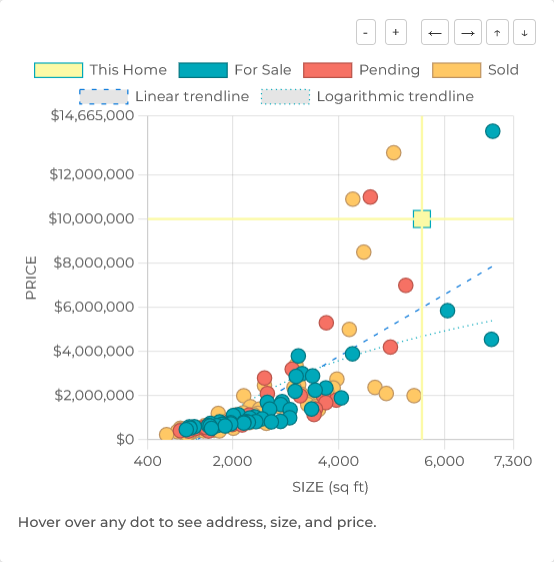
Example chart plotting list, pending, and sold prices versus square footage with a trendline and a highlighted subject home

Example: price vs sq ft with for-sale, pending, and sold comps, plus a trendline and a highlighted subject home.

How to decide if you should price above or below the trendline

This is where most pricing advice gets vague, so here's the practical version:

  • Above the trendline usually means: clearly updated, strong curb appeal, premium lot or view, better layout, or features buyers consistently pay extra for.
  • On the trendline usually means: typical condition for the neighborhood with no major negatives.
  • Below the trendline often means: dated condition, roof/HVAC age concerns, functional obsolescence, traffic noise, awkward layout, or a known neighborhood factor buyers discount.

The honest goal is to match buyer expectations. If buyers feel the price makes sense at a glance, they book showings. If they feel it does not, you get silence.

A simple pricing strategy that works in the real world

Here’s a straightforward way to price without overthinking it:

  1. Start with the strongest sold comps and the strongest pending comps.
  2. Use for sale comps as context, not truth. They show the competition, not what buyers will pay.
  3. Be honest about condition. Buyers do not need perfection, but they do punish surprises.
  4. Choose a number you can justify in one sentence.
  5. Monitor early feedback. If you have strong traffic and no offers, the market is telling you something.

How YELLOW helps with pricing: We don’t just give you a number. We show you the chart, the trendline, and the comps behind it - then we explain where your home should land and why. That way, you can price confidently and adjust strategically if needed.

See selling resources   -   See pricing options   -   Request a pricing review

Common pricing mistakes (and how to avoid them)

  • Pricing off active listings only - actives are competition, not results.
  • Ignoring pending data - pendings often reveal the current buyer appetite.
  • Overpricing “just to test” - you usually lose the best buyers in the first couple weeks.
  • Not adjusting for condition - buyers will, even if you don’t.
  • Chasing the market down too slowly - small, strategic adjustments beat big panic cuts later.

Disclaimer: This page is educational and does not replace an appraisal or professional valuation advice for your specific property. Market conditions change and comparable selection matters.


x
- PLEASE WAIT -
 
x
 
x